Information Retrieval
TrustGraph supports multiple retrieval strategies to provide context to LLM queries. The approach you choose has a significant impact on the quality and accuracy of responses.
Knowledge graph vs. context graph
Knowledge graph
A structured representation of facts about a domain - entities and the relationships between them. It captures what is known.
Context graph
A knowledge graph enriched with the context surrounding that knowledge - where it came from (provenance) and how it has been interpreted and reasoned about (explainability). A context graph recognises that a fact in isolation is less valuable than a fact you can trace back to its source and whose role in previous reasoning you can examine. Crucially, because provenance and explainability are represented as graph data alongside the knowledge itself, they become subjects of further reasoning - you can ask questions not just about what you know, but about how you know it.
The distinction: a knowledge graph captures knowledge; a context graph captures knowledge in context.
Explainable GraphRAG
This is where we started in 2023. GraphRAG is TrustGraph’s flagship retrieval mechanism. Rather than treating documents as opaque text blobs, GraphRAG extracts structured knowledge and stores it in a knowledge graph alongside vector embeddings of entities. TrustGraph engineers were working on GraphRAG before it was ‘cool’.
TrustGraph’s implementation goes well beyond basic GraphRAG. The retrieval pipeline incorporates LLM-driven concept extraction, relevance scoring, edge reasoning, document provenance tracing, and full explainability - making it a truly explainable GraphRAG system.
Overview
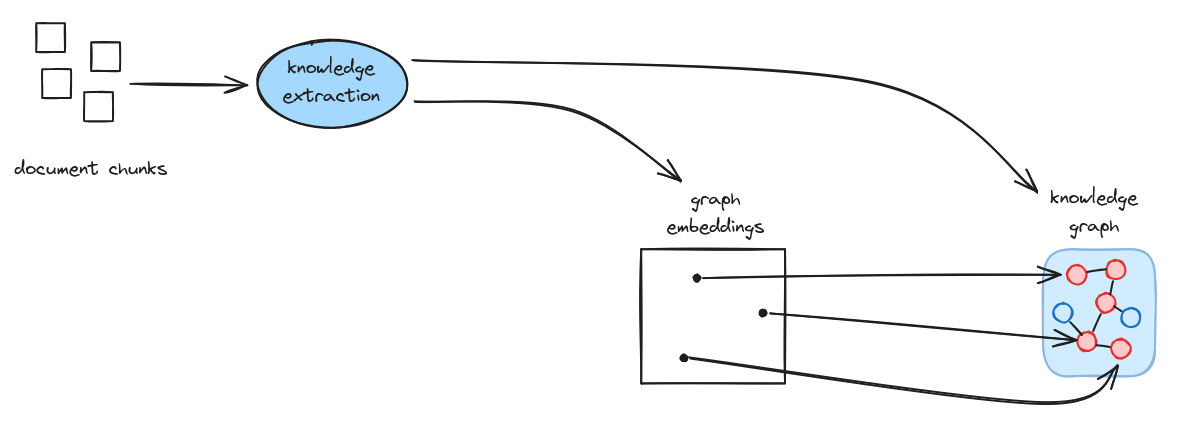
At a high level, document chunks are processed through knowledge extraction to produce both a knowledge graph and graph embeddings for semantic search.
Ingestion
The ingestion pipeline processes documents through several stages:
- Chunking: Documents are split into manageable chunks for processing
- Knowledge extraction: An LLM extracts entities and relationships from each chunk, producing knowledge subgraphs
- Graph loading: The extracted subgraphs are loaded into the knowledge graph
- Entity determination: Entities are identified with their semantic meaning
- Embedding: Entities are embedded into vector space
- Vector store loading: Embeddings are stored for similarity search

Retrieval
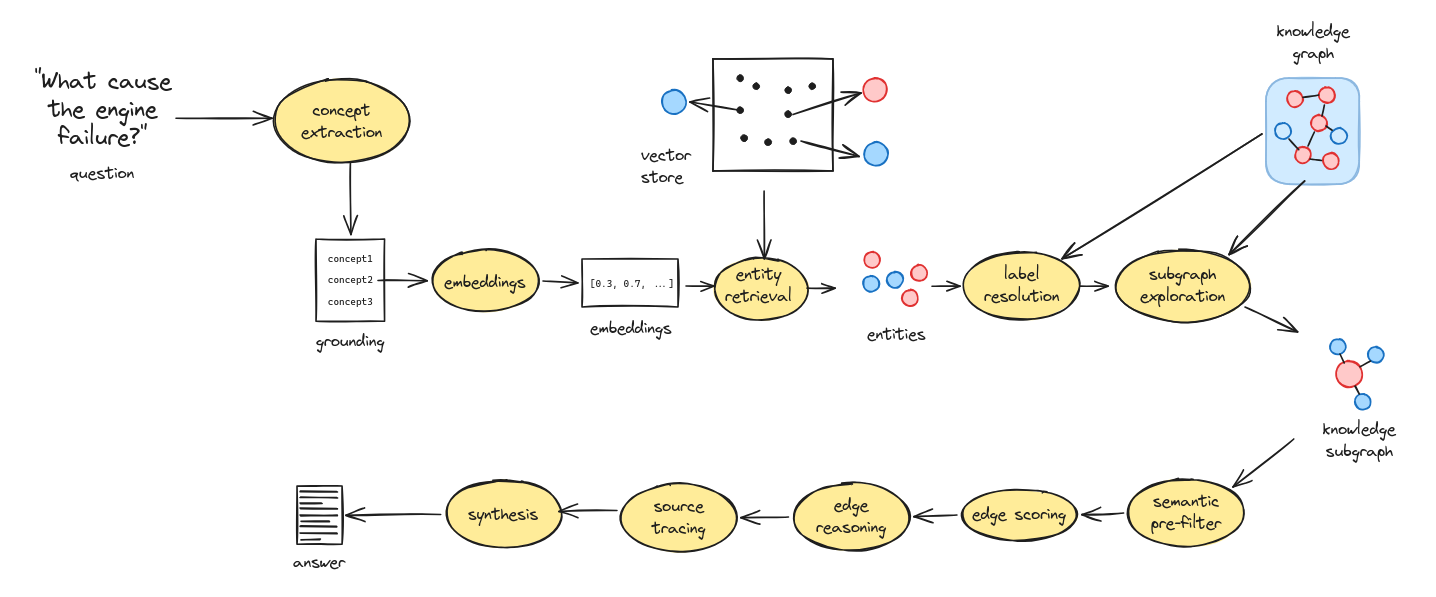
When a question is asked, the explainable GraphRAG retrieval pipeline works through the following stages:
- Concept extraction: An LLM analyses the question and breaks it down into key concepts, providing more nuanced search terms than raw query embedding alone
- Concept embedding: The extracted concepts are converted to vector embeddings for semantic search
- Entity retrieval: For each concept, the graph embeddings store is queried to find semantically relevant entities, with deduplication across concepts
- Subgraph exploration: Starting from the retrieved entities, the knowledge graph is traversed in batches to a configurable depth, collecting a subgraph of related entities and relationships
- Semantic pre-filtering: If the explored subgraph is large, edge descriptions are embedded and scored by cosine similarity to the query concepts, trimming the subgraph to a manageable size
- LLM edge scoring: An LLM assigns relevance scores to each edge in the subgraph, selecting the most pertinent relationships for the query
- Edge reasoning: An LLM provides explanations for why each selected edge is relevant to the question, building a reasoning map
- Document tracing: Selected edges are traced back through provenance chains to their source documents, enabling full attribution
- Answer synthesis: The scored edges, reasoning, and source document metadata are provided to an LLM which generates the final answer
- Explainability: Throughout the pipeline, provenance triples are emitted recording the question, extracted concepts, graph exploration, edge selection with reasoning, and the synthesised answer - providing a complete audit trail for every retrieval
Steps 7 and 8 run concurrently for efficiency.
This approach provides precise, relationship-aware context with full explainability and source attribution, rather than raw text snippets.
Ontology RAG
You have probably heard of GraphRAG before. Ontology RAG, much less likely. So, let’s cover the basics.
Ontologies
Ontologies are structured frameworks that formally define the concepts, relationships, and rules within a specific domain of knowledge. They provide a standardised vocabulary and logical structure for representing how entities relate to each other, enabling both humans and computers to share a consistent understanding of complex information. It’s like a database schema, but for human knowledge.
In knowledge engineering, ontologies have a bad reputation - they are complex, take years to create, and people often have massive disagreements about what ontologies are there to do. Biologists famously disagree about what constitutes a ‘cell’.
But this isn’t to say there’s ‘flaw’ - there’s nothing broken about ontology technology. The real issue is that human knowledge is a profoundly complex experience. When we try to classify human knowledge, we can’t eliminate the fundamental human experiences which come with trying to make sense of the world around us.
So, don’t give up too soon, bringing ontologies into information retrieval produces some awesome results.
Ontology RAG
Ontology RAG extends Graph RAG by incorporating domain ontologies to guide knowledge extraction. This approach is particularly valuable when working with specialised domains that have well-defined conceptual structures. For many use-cases, Ontology extraction results in much improved retrieval results.
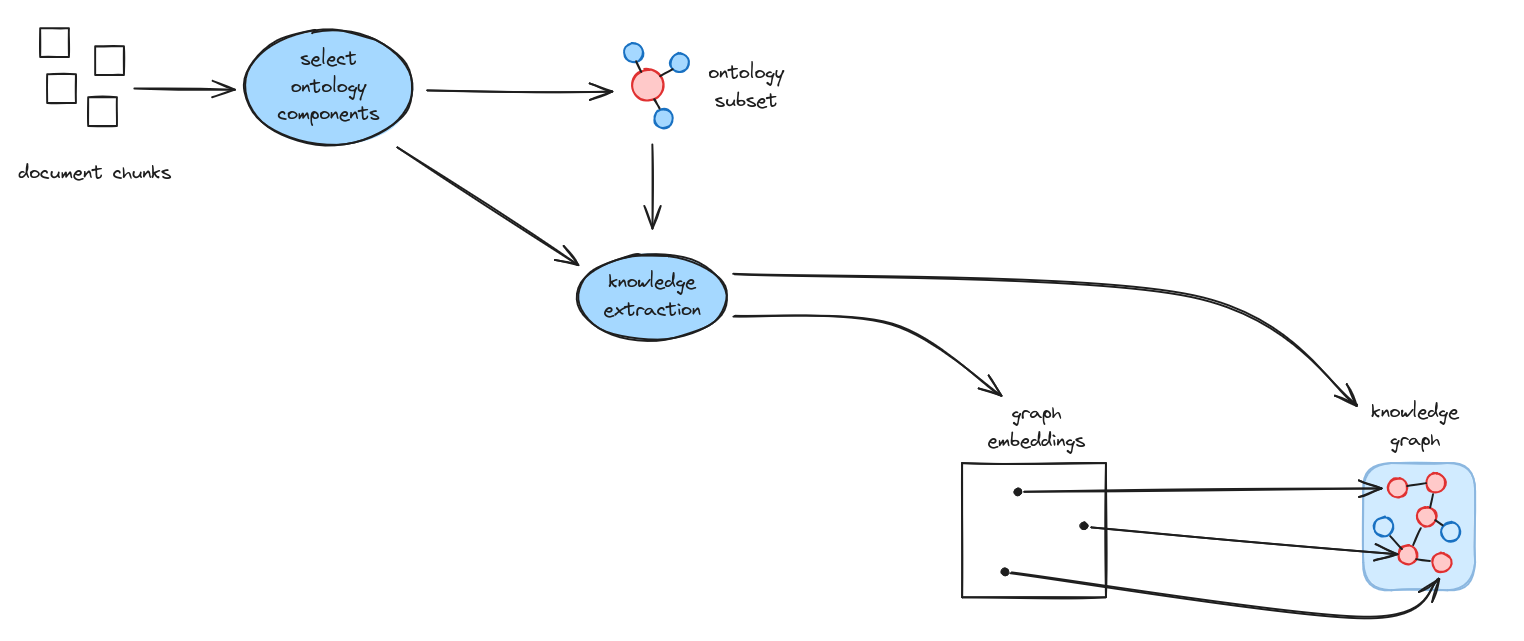
Early attempts at using ontologies in knowledge extraction attempted to guide extraction by loading the full ontology into an LLM context window. Here be dragons: Good ontologies are big, and this can easily flood the context window. In a nutshell, the TrustGraph approach is to apply the GraphRAG algorithm itself to ontologies stored as graph - an information retrieval operation is used to work out the correct subset of ontology components to use for knowledge extraction.
The process begins by selecting relevant ontology components based on the document chunks being processed. This ontology subset then guides the knowledge extraction process, ensuring that extracted entities and relationships conform to the domain model. The result is a more consistent and semantically precise knowledge graph, with embeddings that align with the ontological structure.
Ontology RAG relies on having ontologies. For general purpose text, classifying everything in the world into ontologies would be a Herculean task, so you would stick with GraphRAG for this.
When this technique is widely adopted by all the AI frameworks, remember TrustGraph was pioneering this capability in 2025! 😀
Explainable Document RAG
Document RAG is the traditional approach that dominated early RAG implementations circa 2020. While conceptually simpler than GraphRAG, TrustGraph’s implementation enhances the basic approach with LLM-driven concept extraction for grounding and full explainability tracking, making it an explainable Document RAG system.
Ingestion
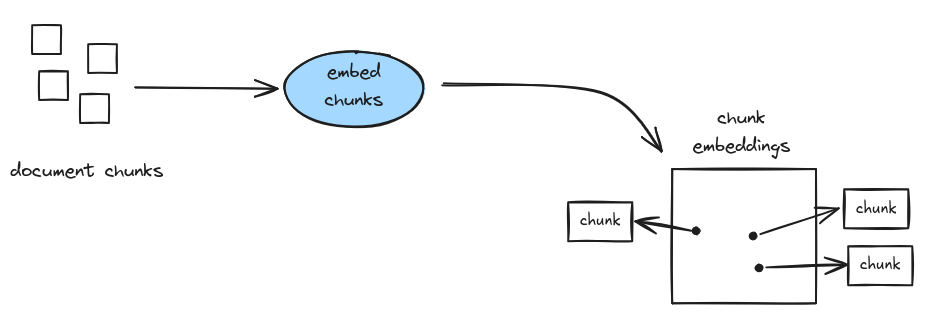
The ingestion pipeline for explainable Document RAG is straightforward: document chunks are embedded directly and stored in a vector database.
Retrieval
When a question is asked, the explainable Document RAG retrieval pipeline works through the following stages:
- Concept extraction: An LLM analyses the question and extracts key concepts, grounding the search in meaningful terms rather than relying on raw query embedding
- Concept embedding: The extracted concepts are converted to vector embeddings
- Chunk retrieval: For each concept, the document embeddings store is queried to find semantically relevant chunks, with deduplication across concepts to avoid repetition
- Answer synthesis: The retrieved chunks and the original query are provided to an LLM which generates the final answer, with support for streaming responses
- Explainability: Provenance triples are emitted at each stage - recording the question, extracted concepts (grounding), retrieved chunks (exploration), and the synthesised answer - providing a complete audit trail
Comparison with GraphRAG
While explainable Document RAG now benefits from concept extraction and explainability, it still has inherent limitations compared to GraphRAG:
- No relationship awareness: Retrieved chunks are isolated text fragments with no understanding of how concepts relate to each other
- Context window pollution: Raw text chunks consume token budget inefficiently compared to structured knowledge
- Poor multi-hop reasoning: Questions requiring synthesis across multiple facts perform poorly when context is fragmented text
For most use cases, explainable GraphRAG or Ontology RAG will deliver substantially better results.